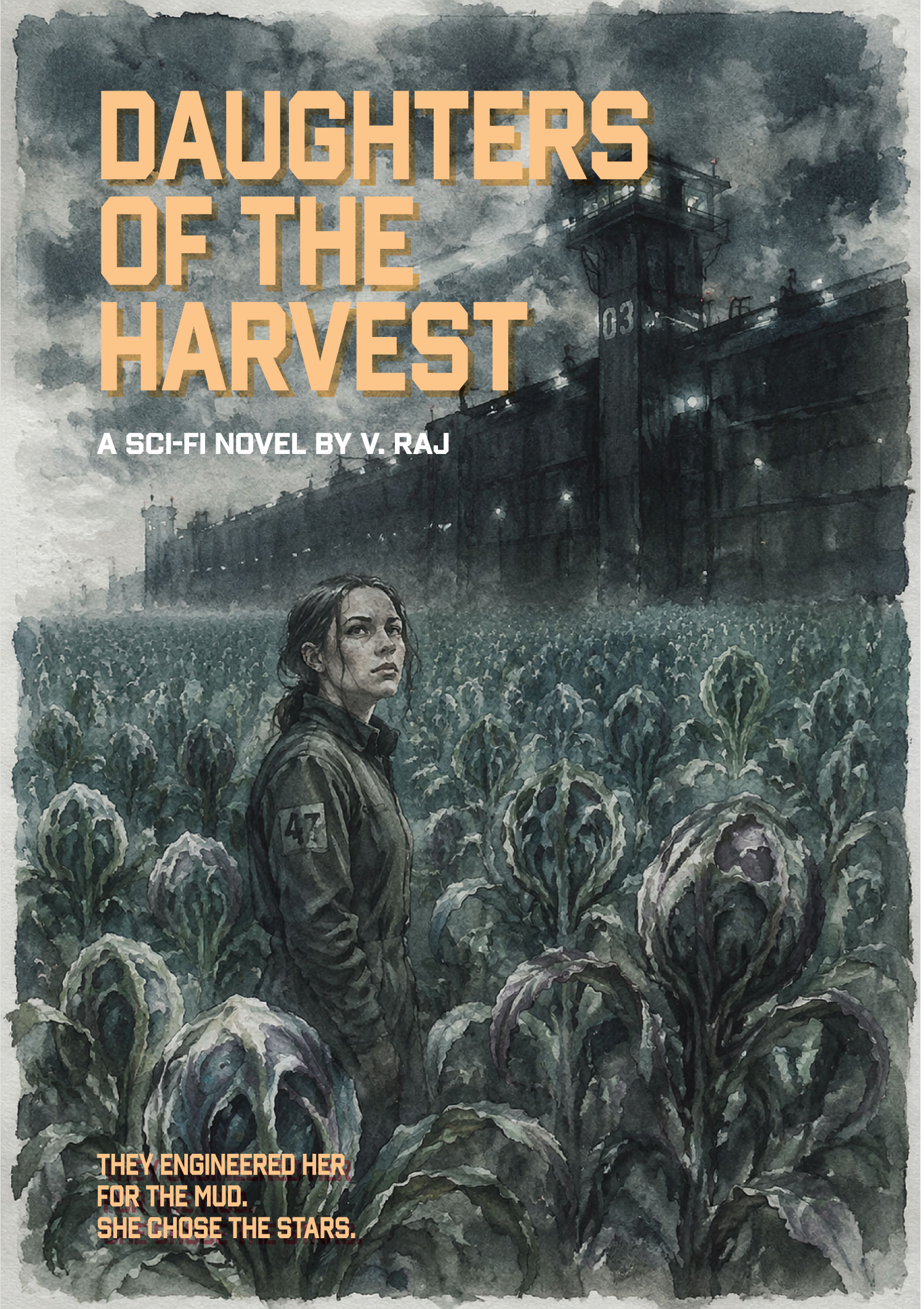
Chapter 1 - The Black Sand and the Leviathan
The ocean of Cytheris-13 did not merely rise; it reached. It reached with a violent, consuming hunger, drawn upward by the colossal weight of the moon hanging in the sky.
Local mud-farmers across the distant continents called the moon the Leviathan. Officially, the Federation designated it F-5412, a sterile alphanumeric tag that failed entirely to capture the terror and majesty of its presence. It dominated the horizon, a bruised sphere of pale, cratered rock so large that its gravity caused a constant, low-frequency tremor in the bones of anyone standing on the planet’s surface. It did not pull the water in gentle waves; it dragged the ocean skyward, creating monumental, fifty-meter tides that crashed against the coastal cliffs with the force of falling mountains.
Quill stood behind a wall of reinforced, floor-to-ceiling glass, watching the black water devour the obsidian beach far below.
His house was a masterpiece of minimalist geometry—smooth gray concrete, sharp angles, and pristine glass, bolted securely to the highest ridge of the coastline. It belonged on this wild, untamed cliffside no more than he did. The tides, as monstrous as they were, never reached the foundation of the house. They would roar and claw at the rock face fifty meters down, spraying fine, salty mist that occasionally kissed the outside of Quill’s window, leaving crystalline streaks when it dried.
Inside, there was only silence. The acoustic dampening of the Federation’s architecture was flawless. Quill could see the fury of the water, but he could only hear the soft, rhythmic hum of the house’s climate control and his own slow breathing.
He raised a steaming mug of black synthetic coffee to his lips, his eyes fixed on the horizon. His hands were gentle, the fingers long and dexterous, bearing the subtle, fading marks of meticulous, repetitive work. There was a quiet weariness etched into the lines around his eyes, a heaviness in his posture that had nothing to do with gravity and everything to do with time.
Beyond the raging ocean, the sky was a canvas of conflicting lights. Cytheris-13 was caught in the embrace of two suns. Aethel, the primary star, was currently rising behind the house over the endless, unseen mud plains of the east. It cast a brilliant, warm golden glow that reflected off the interior of the glass.
But out over the water to the west, setting into the ocean, was Vesper.
Vesper was a distant red dwarf, a dying ember in the deep dark. It provided no warmth, only a haunting crimson glow that bled across the violent crests of the black waves. The farmers called this twilight hour the “Ember Light.” It painted the Leviathan moon in shades of dried blood and shadow, making the celestial giant look like an open wound in the sky.
Quill took a slow sip of his coffee. The bitter liquid grounded him.
He watched the black sand beach disappear entirely beneath the churning tide. In six hours, the water would retreat just as fast, leaving the dark, glittering sands perfectly smooth, wiped clean of any footprints, debris, or imperfections. It was a daily erasure. A violent scrubbing of the world.
Quill often wished his own mind could be washed as cleanly.
He turned away from the window, leaving the Leviathan and the crimson ocean behind him. The interior of the house was spotless. There was a low, gray sofa, a sleek metallic kitchen island, and a single, thriving green fern in a white ceramic pot—a rare luxury of non-edible plant life on a planet dedicated entirely to industrial agriculture. It looked like the home of a wealthy recluse, a sanctuary of peace and modern design.
Nobody looking at it from the outside would ever guess what lay beneath the polished concrete floor.
Quill walked past the kitchen, his soft footsteps making no sound. He approached a seamless gray wall at the end of the corridor. He paused, closing his eyes for a brief moment, gathering himself against the weight of the duty he was about to perform. The month was up. The cycle demanded its toll.
He pressed his palm flat against the cold, blank concrete.
A hidden seam illuminated with a soft, pulsing blue light. A mechanized hiss broke the perfect silence of the house, and the heavy concrete panel slid backward and aside, revealing a starkly lit, descending staircase of brushed steel.
The air that drifted up from the dark was different. It smelled of ozone, sterile disinfectants, and the cold, metallic scent of artificial sleep.
Quill opened his eyes, the weariness in them deepening into profound sorrow. He lowered his mug to a small side table and stepped onto the first steel stair, beginning his descent into the white.
Chapter 2 - Descent into the White
The descent always felt longer than it physically was.
Down, down into the pristine belly of the Federation’s machine. As Quill walked down the brushed steel staircase, the architecture shifted drastically. The textured, comforting concrete of his home gave way to seamless, antibacterial polymer. The temperature dropped by precisely four degrees—a calculated, sterile chill designed to keep the organic processors and suspended biologicals operating at peak efficiency.
Quill stepped off the final stair onto a floor so white and reflective it felt like walking across a mirror of solid ice.
The cavernous room stretched out before him, vast enough to swallow a fleet of interstellar cargo ships. This was the true purpose of the cliffside installation. The beautiful glass house above was merely a capstone, a decorative lid hiding a sprawling, subterranean factory carved deep into the coastal bedrock of Cytheris-13.
Row upon row of towering, cylindrical vats stood at perfect attention. They vanished into the distant, shadowless horizon of the immense room, thousands of them, bathed in the soft, ethereal blue light of stasis fluid.
Inside each cylinder floated a woman.
They were fully grown, suspended in a state of arrested development. Their muscles were automatically conditioned by micro-electrical impulses during their accelerated gestation, ensuring they were physically robust before they ever took their first breath of real air. The Federation did not waste time, calories, or resources on childhood. The agricultural quotas of the galaxy were too demanding. Cytheris-13 was the breadbasket of a thousand worlds, and the endless, freezing mud-trenches required an endless supply of hands.
Quill walked down the central aisle, his reflection a ghostly companion keeping pace on the polished floor. The only sound was the deep, rhythmic thrum of the massive fluid pumps and the whisper of air scrubbers.
He stopped at Terminal Station 4, an angled console of black glass and holographic interfaces. He pressed his hand against the scanner.
Biometric confirmed. Operator Quill. Access granted.
The console flared to life, casting a stark white glow over his tired features. Quill pulled up the harvest schedule for the current cycle. There was only one awakening scheduled for today.
Designation: M-874.
He tapped the screen, waking a hovering medical platform from its alcove, and directed it to follow him down Sector 7, Aisle 87.
He stopped before her vat.
M-874 floated peacefully in the cerulean liquid. Her dark hair fanned out around her face like ink suspended in water. She was breathing oxygenated fluorocarbons, her chest rising and falling in a slow, unnatural, mechanized rhythm. A thick synthetic umbilical cable, attached to the base of her skull, fed nutrients and neural conditioning directly into her nervous system.
Quill placed a hand against the cold, curved glass.
He always felt a profound, suffocating guilt at this stage. To the Federation, the girl behind the glass was farming equipment. A biological machine engineered for docility and physical endurance in the shallow, muddy waters of the harvest zones. But to Quill, in these quiet, stolen moments before the world broke them, they were something sacred. They were innocent.
He walked back to the console to initiate the cognitive upload.
A newly awakened mind was a dangerous, fragile thing. Without a past, an organic brain would collapse under the weight of existential terror and sensory overload. The Federation provided standard memory packages to anchor the clones to reality and, more importantly, to ensure absolute compliance.
Quill brought up the terminal and selected the Coriolis Package.
It was a harsh, unforgiving narrative. As the data began to stream through the umbilical into M-874’s sleeping mind, Quill watched the holographic progress bar, knowing exactly what she was experiencing in her artificial dreams.
She was “remembering” a childhood on the Coriolis moon, a brutal, lightless mining colony in a distant solar system. She was feeling the phantom pangs of childhood starvation, the fabricated sting of her parents’ emotional neglect. She was vividly remembering the day her impoverished parents essentially sold her contract to the Federation’s “Choosing Program” to pay off their insurmountable debts.
The memory package was a masterpiece of psychological manipulation. It was designed to forge a deep, burning resentment toward her non-existent family. It guaranteed she would never look back, never try to steal a ship, and never try to find a way “home,” because home was a place of misery and betrayal.
The only hope woven into her fabricated past was the Choosing Program on Cytheris-13. She was programmed to view her arrival on this planet as an escape, a chance for a better life. It was a beautiful lie built to make her walk willingly into the mud farms.
Quill’s fingers hovered over the console. The Federation rules were absolute. Any deviation from the programming was considered treason against the harvest.
But here, in the dark, isolated beneath the crashing tides of the Leviathan, Quill allowed himself small, desperate rebellions.
He accessed her core identity file. Where the system demanded a blank alphanumeric designation to be etched into her conscious mind, Quill bypassed the security lock. He typed four letters.
Mira.
He didn’t know why he chose that name, only that M-874 was far too cruel a title for someone who was about to inherit such a difficult universe. He embedded the name into her subconscious, making it the first thing she would remember when she opened her eyes.
“Alright, Mira,” Quill whispered to the empty, humming room, his finger resting heavily on the final execution key. “Time to wake up.”
He pressed the key.
The heavy locks on the cylinder clanked open. The blue fluid inside the vat began to rapidly drain.